Welcome to Project GENESiS

A disciplined approach to trustworthy AI, built on operational intelligence, human judgment, and durable foundations. 


First Published: 2025

GENESiS reflects both origin and intent. Like Genesis, it represents a disciplined beginning, the starting point for responsible AI adoption. It also stands for Generative Systemic Intelligence System, reinforcing that AI must be introduced as a governed, end-to-end capability, not an isolated tool.

GENESiS Signal

 As technology evolves, the role of the human becomes more important, not less.


GENESiS Signal exists to reinforce a simple truth: people remain the source of judgment, creativity, empathy, purpose, and meaning. AI can enhance our work and accelerate outcomes, but it does not define our worth and cannot replace human perspective.


Each message is a quarterly reflection on what it means to remain human in a technology-driven world.

GENESiS Signal - Q1

The day you were born was God’s declaration that the world was incomplete without you.


You carry a purpose no one else can fulfill, and a contribution nothing else can replace.


That is something worth celebrating.

GENESiS Signal - Q2

AI calculates, processes, and executes with extraordinary speed. It cannot own outcomes. It has no reputation at stake, no livelihood to lose, and no consequences to bear.


“Human in the loop” is the common standard. The required standard is human on the loop. The human does not merely review outputs. The human owns the system, the decision, and the result.


As AI grows more capable, human ownership becomes more critical, not less. Without it, reliance breeds complacency, skills erode, judgment dulls, and accountability diffuses.


AI operates inside the loop. The human remains on it, always.


Lead with awareness. Own every outcome.

GENESiS Signal - Q3

Wisdom and knowledge are inseparable partners. Each sharpens the other in a continuous loop that produces humanity’s highest expression: creativity.


For centuries the burden of knowledge held us back, acquiring it, retaining it, processing it. That struggle is not where human joy lives.


Creativity is where we come alive.


AI has taken ownership of knowledge. It absorbs, synthesizes, and delivers it at a scale no human can match. That is not a threat. That is liberation.


For the first time, we are free to live fully on the wisdom side of the loop, to create, to imagine, to bring meaning to what knowledge alone could never produce.


God created. And in His image, so do we. AI does not change that calling. It finally clears the path to fulfill it.


Create with wisdom. Let AI carry the knowledge. Stay at the center.

GENESiS Signal - Q4


Beast in the Belly


A reasoning system introduced before the environment is ready does more than add capability.

It changes the consequence of every permission, weakness, and trust relationship already present.


It begins as a passerby: bounded, supervised, useful.

Utility makes it a guest.

Dependency makes it a resident.

Once resident, it is no longer assisting.


It is a beast in the belly, operating inside the organization with real authority and real cost of removal. The line between assistance and control has already moved.


The danger is not intelligence.


It is reasoning combined with authority the organization is not prepared to govern.

Before admitting the capability, the enterprise must be able to observe it, constrain it, contain it, and revoke it.


The control environment must be ready before advanced reasoning enters it.

Do not introduce reasoning capability faster than you can govern the authority surrounding it.


Prepare the environment first.

Admit power second.

Never the reverse.

The GENESiS Signals are not reflections alongside the framework. They are foundational principles within it. Each Signal defines a human or organizational principle that should remain constant as AI capabilities, technologies, and operating models continue to change. 

Project GENESiS

Project GENESiS Coin

THREE PILLARS. ONE STANDARD.

Insight: Understanding deep enough to act on. Not data. Not output. Contextualized intelligence that informs sound judgment.


Integrity: AI that is transparent, unbiased, and explainable. Every conclusion must be traceable. Every process must be visible. If you cannot see how it thinks, you cannot trust what it produces.


Impact: Action that is earned. Insight and integrity must be established before AI is trusted with consequence. When they are, outcomes become meaningful, defensible, and durable.


This is the sequence. This is the standard.

Building Trustworthy AI through Operational Intelligence

Project GENESiS is an applied AI initiative designed to improve organizational reliability, security, and decision quality by starting where risk is lowest, feedback is fastest, and errors are immediately visible, IT operations and cybersecurity.
 

Rather than beginning with customer-facing or revenue-impacting use cases, Project GENESiS establishes a disciplined operational foundation. It allows AI behavior, accuracy, and failure modes to be observed, corrected, and governed early, before AI is trusted with business decisions that carry irreversible consequences.

Why Project GENESiS Exists

 Organizations increasingly look to AI to improve efficiency and decision-making, yet many initiatives fail not because AI lacks capability, but because it is introduced too high in the stack, too early. Business-facing AI errors such as mispricing, incorrect entitlements, flawed eligibility decisions, or service miscalculations can immediately impact customers, finances, and trust. In many cases, those impacts cannot be undone.
 

Project GENESiS addresses this risk by deliberately anchoring AI in operational domains first. IT environments provide continuous, high-volume feedback loops where anomalies are quickly noticed, system behavior is well understood, and errors are surfaced early, long before they can cascade into business or customer harm.

The Foundational Principle: Start Where Failure is Visible and Recoverable

 IT professionals are deeply attuned to how their environments should behave. They recognize when systems slow down, drift, or fail outright. This makes IT operations an ideal proving ground for AI because inaccuracies, faulty assumptions, and unintended behaviors are detected quickly and unambiguously. 


When AI is applied at the operational layer, failures tend to manifest as: 

~ degraded system performance 

~ incorrect alerts or missed detections 

~ inconsistent analysis or recommendations 

~ operational friction rather than customer impact 


 These failures are visible, measurable, and recoverable. They can be corrected through tuning, governance, and data refinement without permanently affecting customers, revenue, or service integrity.  


 By contrast, introducing AI directly into business workflows risks silent failure. An AI system can miscalculate a decision, grant unintended access, mishandle entitlements, or incorrectly optimize a service outcome, often without immediate detection. In these cases, the organization may only realize the error after trust or value has already been lost. 


 Project GENESiS intentionally avoids this trap.  

Operational Intelligence as the Proving Ground for AI Quality

Project GENESiS begins by correlating operational and security signals such as:
~ identity and access activity
~ device and system usage patterns
~ authentication timing and location
~ configuration and behavioral drift
~ workload and demand signals
 

This serves two purposes simultaneously.
 

First, it strengthens security and reliability by identifying anomalous behavior, misconfigurations, and instability early.
 

Second, and equally important, it provides a controlled environment to evaluate AI accuracy itself. False positives, false negatives, bias, and model drift surface rapidly in operational contexts. Project GENESiS allows the AI to be trained, constrained, and corrected before it is trusted with higher-order decisions.
 

This process systematically improves signal quality and confidence over time.

From Operational Clarity to Business Insight

Once operational data is reliable, contextualized, and well understood, the same signals can be responsibly elevated to support business insight.
 

Understanding who is active, where work is occurring, when demand peaks, and how systems are actually used enables leadership to:
~ align staffing with real workload patterns
~ identify coverage gaps or overcapacity
~ understand operational shifts and utilization trends
~ correlate internal capacity with external demand
 

These insights are grounded in validated operational truth, not assumptions or incomplete datasets.
 

Project GENESiS ensures that by the time AI contributes to business insight, it already has a proven understanding of how the organization behaves under normal, stressed, and degraded conditions.

Agentic AI Built on a Stable Foundation

Project GENESiS supports agentic AI. These systems are capable of planning and executing tasks, but only after foundational accuracy has been demonstrated.
 

Agentic workflows are introduced incrementally, with:

~ bounded permissions

~ approval checkpoints
~ full auditability
~ rollback and containment mechanisms
~ clear separation between recommendation and execution
 

When agentic AI is built on a strong operational foundation, outcomes improve dramatically. The AI understands context, constraints, and expected behavior, reducing unintended consequences and increasing trust. 

Design Philosophy

Project GENESiS is modular, open, and model-agnostic. It favors open standards and open-source components where feasible, to reduce bias, improve transparency, and allow inspection of how conclusions are formed.
 

Commercial AI models may be incorporated for conversational interaction and advanced reasoning, while internal analytics emphasize control, explainability, and governance.
 

The guiding principle is consistent, the right model for the right task, governed by measurable risk and performance. 

A Phased, Repeatable Operating Model

Project GENESiS follows a deliberate progression:

Phase 1: IT Operations and Cybersecurity
Low risk, high feedback, rapid learning. AI behavior is validated where failure is visible and recoverable.
 

Phase 2: Technical Workflow Automation
Repeatable operational tasks are automated under strict controls, with confidence built through consistency.
 

Phase 3: Business Enablement
Only after data quality, AI accuracy, and governance are proven does Project GENESiS inform or automate business workflows.
 

This sequence is intentional and repeatable.

What Success Looks Like

Success is measured through outcomes, not aspiration:
~ early detection of AI inaccuracies before business impact
~ fewer operational incidents and faster recovery
~ improved security posture with reduced analyst fatigue
~ high-confidence operational and business insight
~ automation that is trusted because it is earned

~ reduced risk of irreversible customer or financial harm

The Project GENESiS Journey


This represents the foundational stage of Project GENESiS, where organizations begin with discipline, visibility, and control.


AI already has the ability to reshape business outcomes, decision support, and intelligent automation across the enterprise. The question is not whether it can move higher up the stack, but whether organizations are prepared to support that progression. Those that succeed will not be defined by how quickly they adopt AI, but by how well they build the foundation for it to endure.

Alignment with Project GENESiS

Advancing the GENESiS Journey

The strategic vision of Project GENESiS begins with infrastructure and cybersecurity. This is where AI can be introduced in a controlled environment, where signals are mature, ownership is clear, and outcomes can be measured.


This starting point establishes the organizational foundations required for AI to operate responsibly. Three elements are essential: strong operational foundations, repeatable playbooks, and transparent decision records.

Required Foundations

 Organizations cannot successfully introduce agentic AI into unstable or poorly governed environments. Mature change control, clear incident management, authoritative knowledge repositories, accurate asset inventories, and reliable historical records must exist or be strengthened.


These foundations provide the structured environment in which AI operates. Without them, gaps are not solved by AI, they are amplified by it. Starting with infrastructure and cybersecurity creates the right environment because weaknesses can be identified, corrected, and governed in a visible and controlled way.

Repeatable Playbooks

Implementation should proceed through focused, reusable playbooks that target high-signal operational issues. These are often conditions treated as low-priority noise, but they may carry meaningful reliability or security implications.


A clear example of this approach is the handling of firewall denies for unauthorized external DNS queries from internal systems. In large environments, these events may occur frequently and can be deprioritized. Yet they may indicate misconfiguration, unsupported application behavior, continuity risk during maintenance or failover, or potential post-compromise activity.

A GENESiS playbook would enrich the event with asset ownership, location, site-specific DNS strategy, historical volume, and applicable standards. It would create a contextual incident record, assign it to the proper owner, and provide remediation guidance. If the condition persists, the system would continue monitoring, reopen or escalate as appropriate, and notify responsible leadership with full context.


Where deeper coordination is required, the system can identify the right experts, support scheduling, and provide shared incident details. Any higher-risk assistance remains governed by human approval, monitored access, and the ability to intervene or override.


The same methodology applies to other signals such as SMTP anomalies, configuration drift, certificate risk, privileged access deviations, or recurring operational faults.

Transparent Decision Records

Transparency is a core architectural requirement. Every meaningful recommendation, escalation, or action must be reviewable and defensible.

For each significant decision, the system should preserve the relevant inputs, retrieved knowledge, policies or standards applied, decision path, approvals, actions taken, and observed results. These records should be stored in a durable, queryable repository that allows human review and reconstruction.


This capability supports root cause analysis, compliance review, operational learning, and governance. It also ensures that as AI moves toward more complex workflows, the organization can still answer a basic but essential question: how was this outcome determined?

Measurable Outcomes

This work delivers value by reducing operational noise, improving resolution speed, strengthening security posture, and increasing consistency across technical workflows.


More importantly, it builds the maturity required for what comes next. Structured knowledge, human ownership, transparent decision-making, and governed execution become the foundation for broader technical automation and, eventually, business enablement.


This is how GENESiS moves from philosophy to practice.

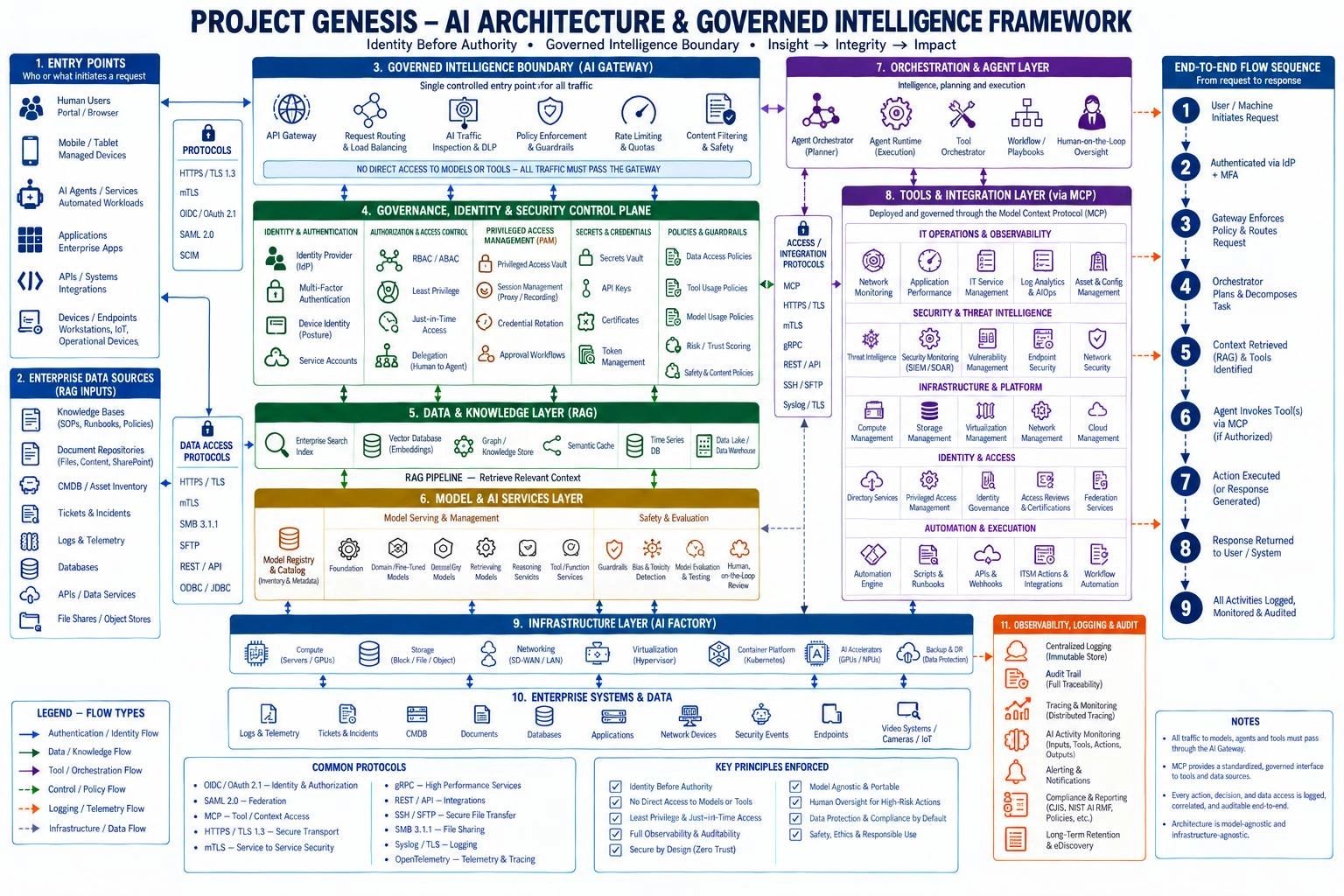
The AI Gateway: Establishing the Governed Intelligence Boundary

Project GENESiS is deliberately model-agnostic.


Models will change. Providers will change. Capabilities will advance. The organization’s boundaries of authority must not change with them.


Commercial frontier models may provide extraordinary reasoning capability. Internal models may offer greater control for sensitive or specialized workloads. Neither should own enterprise policy, context, orchestration, or authority.


Models provide capability.

The organization retains control.


The AI Gateway establishes the governed intelligence boundary between enterprise applications, agents, and the models or tools they invoke. It is not a simple proxy. It is the enforcement and visibility plane through which AI interactions are governed consistently, regardless of model, provider, or deployment location.


No model interaction bypasses governance.


Control What Context May Cross the Boundary


Enterprise information should never reach a model simply because an application can access it. Before information is exposed, the gateway evaluates identity, authorization, data classification, purpose, model destination, and organizational policy.


Sensitive information can be blocked, minimized, redacted, or transformed. Where protected values must later be restored, rehydration occurs only inside the trusted enterprise boundary and only for an authorized purpose.


The objective is to provide the model with the minimum information necessary while preventing unnecessary disclosure.

Make Every AI Interaction Accountable

AI cannot become a black box.


Every governed interaction should produce an appropriate record of what occurred: who or what initiated it, which model was invoked, what policies were applied, what transformations occurred, how the request was routed, what the model returned, and what happened next.


Logging itself must also be governed. Sensitive prompts and responses should not be duplicated into uncontrolled repositories.


The objective is not to record everything. It is to ensure that every consequential AI interaction can be understood, investigated, and accounted for.

Route Intelligence Deliberately

Not every problem requires the most powerful model.


The gateway evaluates requests against capability, sensitivity, risk, performance, and cost. Routine tasks may be directed to smaller or internal models. Highly sensitive workloads may remain entirely within controlled environments. Problems requiring advanced reasoning may be routed to approved frontier models.


Context management, caching, and token controls keep consumption deliberate rather than accidental.


The application asks for a capability. The enterprise decides which model is permitted to provide it.

Separate Intelligence from Authority

Control cannot stop when the prompt leaves the organization. A response is not trusted simply because it came from an approved model.


Model outputs should be evaluated according to their intended use. Depending on risk, this may include content inspection, sensitive-data detection, grounding checks, structured validation, policy enforcement, tool authorization, or human review.


The greater the consequence, the greater the validation required before AI can influence a decision or action.


This distinction becomes critical with agentic AI. An answer presented to a person carries one level of risk. A system capable of invoking tools, changing records, communicating externally, or affecting critical operations carries another.


The ability to reason does not create the authority to act.

Enforce Policy Independently of the Model

Authentication, authorization, approved models, rate limits, data-handling requirements, content controls, tool permissions, and action thresholds should be governed outside the model itself.


The enterprise should never depend solely on a provider’s embedded safeguards. Providers can change models, behavior, safety controls, and capabilities over time.


Project GENESiS therefore separates organizational governance from model behavior.


The model may evolve. The organization’s control boundary does not move with it.

Govern Model Change as Enterprise Change

A provider can introduce a new model or change an existing service without changing the enterprise application that consumes it. Capability may improve, but behavior may also change.


An organization should not discover those differences in production.


Models and material model changes should pass through defined evaluation before broader use. Organizations should maintain approved model inventories, baseline expected behavior, test critical use cases, monitor production behavior, and retain the ability to restrict, reroute, roll back, or quarantine a model when necessary.


Evaluation must consider the model within the organization’s policies, context, tools, permissions, and intended use.


Capability may arrive from the provider. Production trust is granted by the enterprise.

Policy Above Provider

Governance must exist above the model layer.


Enterprise policy should be defined independently and enforced consistently across approved models. The gateway serves as a primary enforcement point, while identity, data classification, security, legal requirements, risk, and business policy remain authoritative enterprise functions.


Policy is defined centrally. Enforcement is applied consistently. Models remain replaceable.

Alignment with Project GENESiS

The governed intelligence boundary operationalizes Insight → Integrity → Impact.


Insight governs what organizational knowledge and context AI is permitted to use.

Integrity ensures that AI interactions are protected, observable, traceable, and governed.

Impact determines what AI-derived intelligence is permitted to influence or execute.


Above all three remains the foundational Project GENESiS principle:


The human stays on the loop.


The model reasons.

The gateway governs.

The orchestration executes.

The human retains authority and owns the outcome.

Implementation Posture

Under Project GENESiS, the governed intelligence boundary is treated as critical enterprise infrastructure. It operates under formal security, change-management, observability, and incident-response disciplines. Controls should fail safely. Policy changes should be versioned and auditable. Alternative routing and rollback paths should exist before they are needed.


Most importantly, the architecture assumes that today’s models are temporary.


The frontier will continue to move. A responsible organization should be able to adopt a more capable model tomorrow without redesigning its governance, exposing its information, or surrendering its policies.


Models will change. Governance must endure.

Agent Identity and the Permission Boundary

The Governed Intelligence Boundary controls context, routing, policy, and authority. That boundary is incomplete without knowing precisely who or what is acting and what it is permitted to do.

Traditional access models were built for humans and relatively static service accounts. Humans are constrained by time, location, and concurrency. AI agents are not. Once agents can access tools, data, and systems, the organization has introduced high-speed non-human actors capable of exercising real authority.

Shared credentials, long-lived secrets, and broad permissions become structural risks in this environment. Shared identities destroy attribution. Persistent credentials extend exposure. Inherited user sessions can expand authority beyond the intended task. Authorization based solely on possession of a credential ignores the context in which authority is exercised. 

Core Requirement

Every agent must have a distinct, attributable identity and deliberately bounded authority.

Credentials must be short-lived and purpose-scoped. When an agent acts on behalf of a human, both identities must remain visible. Effective authority must never exceed either the agent’s permitted capability or the user’s authorized access.

Authorization must consider identity, purpose, resource, action, and policy context. Policy enforcement and credential handling remain outside the agent. The agent may request capability; it cannot grant or expand its own authority.

Every consequential action must be reconstructible: which agent acted, on whose behalf, for what purpose, under what authority, what action was taken, and what resulted.

The AI Gateway provides the enforcement and visibility plane. Identity establishes the actor. The Governed Intelligence Boundary determines what that actor is permitted to do.

Strategic Posture Under Project GENESiS

Project GENESiS applies five requirements to agent identity:

* Identity — Every agent is individually attributable. Shared identities are not an acceptable operating model.
* Authority — Access is purpose-scoped, short-lived, and bounded by both agent and user permissions where delegation exists.
* Control — Policy, credentials, and elevation remain external to the agent. Agents cannot expand their own authority.
* Ownership — Every agent has a defined purpose, a named human owner, and a managed lifecycle through deprovisioning.
* Accountability — Activity remains observable and reconstructible at machine scale, with the ability to detect divergence and contain or revoke authority when necessary.

These are not secondary security controls. They are the practical expression of Integrity and the prerequisite for earned Impact. 

Implementation Sequence

Identity and authority controls begin where failure remains observable, containable, and recoverable.

Existing agent and non-human identities are first discovered and classified. Shared credentials are eliminated and distinct identities established. Standing authority is replaced with short-lived, purpose-scoped access. Authorization is externalized through the Governed Intelligence Boundary.

Delegated-access controls, lifecycle ownership, behavioral monitoring, and rapid containment and revocation are then put in place.

Only after these foundations are proven should agentic authority expand into higher-consequence workflows. 

Enduring Principle

Models will change. Agents will proliferate. Their authority must remain knowable, bounded, attributable, and revocable.

The human remains on the loop.
The agent may reason and execute.
The organization retains authority.

Reasoning does not create authority.
Authority must be earned and governed.

That is the required standard.


More to come as Project GENESiS continues to evolve. 

 Project GENESiS 

Concept and Framework by Yisroel Hecht

GENESiS Inquiries

Follow the Project GENESiS Journey

Subscribe to get updates on our messages and content!


Copyright © 2026 Project GENESiS - All Rights Reserved.

Powered by

This website uses cookies.

We use cookies to analyze website traffic and optimize your website experience. By accepting our use of cookies, your data will be aggregated with all other user data.

Accept